
House of Fado

Skip to product information
1 of 1
1-4
30-60
1-4
30-60

Some Portuguese restaurants are serving typical Portuguese food along with performances of Fado - an iconic world-renowned traditional portuguese music - delivering customers a profoundly expressive style of Portuguese music

People spend the evening in these restaurants just to hear this music. It speaks about "Saudade" (a Portuguese word meaning "longing, nostalgia, yearning, missing something or someone" that is unique from Portugal).

Those restaurants are called Casa de Fado (House of Fado).
Usually, there isn't any rotation of the tables. Once you go to those restaurants, you stay until it's closed. Fado is normally played by a trio of musicians and that is how it is represented in its most traditional way.

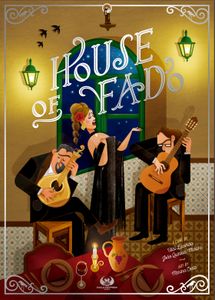
On the left, a guitarist plays "Guitarra Portuguesa" (a 12-string Portuguese Guitar). In the middle is a singer, and on their right a guitarist playing "Viola de Fado" (classical guitar).

These singers are called FADISTAS.
The Portuguese guitar has a very unique sound and the chords are played in different bars from those in classic guitar.

In the game, players will have to manage the restaurant, attract customers and contract and promote fadistas, thus gaining prestige for their fado house.

Managers will move their staff members to different places to perform some actions.

Having a KO action, based on the Gallerist, this become a straight forward fast-paced 1-hour game, but still very challenging as usual in Lacerda style.

After Bot factory, this is the 2nd game designed by Vital along with João Quintela Martins.

If you want to learn more about Fado, here is how Wikipedia defines Fado:

"Fado (Portuguese pronunciation: [ˈfaðu]; "destiny, fate") is a music genre that can be traced to the 1820s in Lisbon, Portugal, but probably has much earlier origins. Fado historian and scholar Rui Vieira Nery states that "the only reliable information on the history of fado was orally transmitted and goes back to the 1820s and 1830s at best. But even that information was frequently modified within the generational transmission process that made it reach us today."

Although the origins are difficult to trace, today fado is commonly regarded as simply a form of song which can be about anything, but must follow a certain traditional structure. In popular belief, fado is a form of music characterized by mournful tunes and lyrics, often about the sea or the life of the poor, and infused with a sentiment of resignation, fate and melancholy. This is loosely captured by the Portuguese word saudade, or longing, symbolizing a feeling of loss (a permanent, irreparable loss and its consequent lifelong damage).
Famous singers of fado include Maria Teresa de Noronha, Alfredo Marceneiro, D. Vicente da Câmara, Frei Hermano da Câmara, Amália Rodrigues, Dulce Pontes, Carlos do Carmo, Mariza, Mafalda Arnauth, António Zambujo, Ana Moura, Camané, Helder Moutinho, Carminho, Mísia, Cristina Branco, Gisela João and Katia Guerreiro.
On 27 November 2011, fado was added to the UNESCO Intangible Cultural Heritage Lists."

—description from the designer
House of Fado

1-4
30-60
1-4
30-60

Some Portuguese restaurants are serving typical Portuguese food along with performances of Fado - an iconic world-renowned traditional portuguese music - delivering customers a profoundly expressive style of Portuguese music

People spend the evening in these restaurants just to hear this music. It speaks about "Saudade" (a Portuguese word meaning "longing, nostalgia, yearning, missing something or someone" that is unique from Portugal).

Those restaurants are called Casa de Fado (House of Fado).
Usually, there isn't any rotation of the tables. Once you go to those restaurants, you stay until it's closed. Fado is normally played by a trio of musicians and that is how it is represented in its most traditional way.

On the left, a guitarist plays "Guitarra Portuguesa" (a 12-string Portuguese Guitar). In the middle is a singer, and on their right a guitarist playing "Viola de Fado" (classical guitar).

These singers are called FADISTAS.
The Portuguese guitar has a very unique sound and the chords are played in different bars from those in classic guitar.

In the game, players will have to manage the restaurant, attract customers and contract and promote fadistas, thus gaining prestige for their fado house.

Managers will move their staff members to different places to perform some actions.

Having a KO action, based on the Gallerist, this become a straight forward fast-paced 1-hour game, but still very challenging as usual in Lacerda style.

After Bot factory, this is the 2nd game designed by Vital along with João Quintela Martins.

If you want to learn more about Fado, here is how Wikipedia defines Fado:

"Fado (Portuguese pronunciation: [ˈfaðu]; "destiny, fate") is a music genre that can be traced to the 1820s in Lisbon, Portugal, but probably has much earlier origins. Fado historian and scholar Rui Vieira Nery states that "the only reliable information on the history of fado was orally transmitted and goes back to the 1820s and 1830s at best. But even that information was frequently modified within the generational transmission process that made it reach us today."

Although the origins are difficult to trace, today fado is commonly regarded as simply a form of song which can be about anything, but must follow a certain traditional structure. In popular belief, fado is a form of music characterized by mournful tunes and lyrics, often about the sea or the life of the poor, and infused with a sentiment of resignation, fate and melancholy. This is loosely captured by the Portuguese word saudade, or longing, symbolizing a feeling of loss (a permanent, irreparable loss and its consequent lifelong damage).
Famous singers of fado include Maria Teresa de Noronha, Alfredo Marceneiro, D. Vicente da Câmara, Frei Hermano da Câmara, Amália Rodrigues, Dulce Pontes, Carlos do Carmo, Mariza, Mafalda Arnauth, António Zambujo, Ana Moura, Camané, Helder Moutinho, Carminho, Mísia, Cristina Branco, Gisela João and Katia Guerreiro.
On 27 November 2011, fado was added to the UNESCO Intangible Cultural Heritage Lists."

—description from the designer

Eagle-Gryphon Games

Regular price $59.99 USD
Regular price Sale price $59.99 USD
Sale Sold out
Shipping calculated at checkout.
View full details